This week I was reminded of the following event. During some of our grade school years we brown-bagged our lunch daily. I remember one day getting what I thought was MY brown bag from where the class kept their lunches. I opened it up and it was like, OMIGOD, a meatloaf sandwich! Yeah Mom!!! Just then another boy at our table opened what he thought was HIS brown bag lunch and, almost in tears, shouted "A Cheese Whiz sandwich? What the hell's wrong with her?" I didn't say a word and enjoyed eating his lunch.
Friday, April 22, 2011

Thursday, April 14, 2011
Fr. Peter Whelan, O.S..B., C.S.A.
To describe the life and times of one immigrant to the American South could be also be aptly titled "Holy Men in Modern Times." One chapter would describe Wexford-born Peter Whelan. Oh, he was human, to be sure, but his devotion to God and his fellow man is evident in the way he chose to live his life. He was also a Confederate Chaplain to Irish-Americans in the Montgomery Guards, part of the 1st Georgia Volunteers.
 Peter Whelan was born in 1802 in County Wexford, Ireland. He attended Birchfield College in Kilkenny for two years, where he received classical and mathematical education. He may have been influenced by the desperate appeal of John England, the bishop of the new diocese of Charleston, South Carolina. Priests were sorely needed, particularly in the South. He was ordained a priest of the Benedictine Order in Charleston on November 21, 1830. He offered his first Mass in the state of Georgia in 1835 in the home of Robert Semmes. In 1854 a yellow fever epidemic claimed the life of Savannah's first Bishop, Frances Gartland in 1854. Father Whelan was summoned to Savannah and was stationed there for the remainder of his life.
 In September 1861 Bishop Augustine Verot was named the third Bishop of the Savannah Diocese, which was formed in 1850. Arriving at his new post from Florida, he was asked to send a chaplain to Fort Pulaski. The Fort, on the Savannah River, guarded the approaches to the city. It was thought to be impregnable as no artillery shells could be directed at it from any nearby land. Part of the garrison there were Catholic troops, in particular the Montgomery Guards, mostly Irish from Savannah.
The militia unit was organized on August 20, 1861. Not having their own banner, Captain Lawrence J. Guilmartin contacted the Sisters of Mercy in Savannah. After Mass on Saint Patrick's Day, 1862, a presentation ceremony was held. Private Bernard O'Neill was appointed standard-bearer and Major John Foley presented it to him.
Father Whelan was present on April 10, 1862 when Federal forces began an artillery bombardment of the Fort. Using new 'rifled' artillery, the rounds were able to reach the outer walls from Tybee Island, more than a mile away. Thirty hours later, with one wall breached by the shot, it was determined that the entire ammunition magazine was in danger of exploding. If that happened the entire garrison would be killed. Colonel Charles H. Olmstead agreed to surrender. Now prisoners-of-war, Father Whelan and the Montgomery Guards were transported to Governor's Island, New York. Bernard O'Neill hid the banner on his person.
Wartime conditions persisted for prisoners and Father Whelan, through the office of Father William Quinn, pastor of St. Peter's Church, Barclay St., New York, applied for the position of Prison Chaplain so he could offer daily Mass at Castle William. Through Father Quinn he was discharged and put on parole. Father Whelan could have left but he chose to remain with his men and minister to them. He eventually returned to Savannah where the Vicar General assigned him the task of overseeing the spiritual needs of the confederate military posts in Georgia.
On one occasion another Confederate chaplain, the Reverend James Sheeran of the Fourteenth Louisiana, on leave from Virginia, visited him. In his diary he observed, “He stands nearly six feet with drab hair, coarse ill shaped countenance, round or swinging shoulders, long arms, short body and long legs, with feet of more than ordinary size.... One day he met a brother priest, to whom nature was no more liberal than to himself. "Well," said he, "...your mother and mine must have been women of great virtue....because they did not drown us when the first saw us. None but mothers of great...patience would have raised such ugly specimens of humanity."

During May of the same year Fr. William Hamilton, pastor of Assumption Church in Macon, accidentally came upon Andersonville Prison and stopped to learn how many Catholics were there. His experience led him to petition the Vicar, suggesting a priest be provided; Father Whelan was asked. He arrived at Andersonville on June 16, 1864. Even though other priests and the Bishop visited briefly, Whelan remained for four months. Although he never penned his feelings, a pastor from Macon did. "I found the stockade extremely filthy: the men all huddled together and covered with vermin....they had nothing under them but the ground."

At the age of sixty-nine, and in failing health from his wartime tribulations, he administered his last baptism in 1871 and died in February of the same year. The funeral procession was reported in the Savannah Evening News as the longest ever seen in the city. After a 10:00 a.m. Mass a procession of eighty-six carriages and buggies of civilians, religious societies and Irish organizations escorted his mortal remains through Savannah's crowd-lined streets to the Catholic Cemetery. Colonel Olmstead led Confederate Army and Navy veterans. An officer who knew Father Whelan said, "I followed this good old man to his grave with a sense of exultation as I thought of the welcome that awaited him from the Master whose spirit he had caught and made the rule of his life."
Bibliography
Gilliam Bowen, Diocese of Savannah
Father Whelan of Fort Pulaski and Andersonville, Georgia Historical Quarterly, Spring, 1987.
Fr. .,
Wednesday, April 13, 2011
US WAR HEROES HONORED IN CO. MAYO, IRELAND
U.S War Heroes are honoured in County Mayo
Many world historians claim that the USA America and a lot of those were emigrants from Europe who were drafted soon after they arrived in America US war cemeteries scattered around Europe, and they are a testament to America
The US government in a very humanitarian gesture, offered to repatriate the bodies of fallen soldiers to their home places in Europe , if the families requested this. In County Mayo on the West Coast of Ireland, an area, which actually faces out across the Atlantic Ocean towards America
Some bodies were repatriated and buried , then they were forgotten, their families were poor and probably couldn’t afford the money to develop the graves at the time, so with the passing of the years, there was no sign of a grave or even a marker to say that they existed, with hindsight it would have far been better if they were buried in the U.S military cemeteries in Europe where they would have received the respect and attention they had earned & deserved.
For the past two years in County Mayo
The trio are led by the Chairman of the Mayo Peace Park , Garden of Remembrance Dixon , Illinois does the rest, Pat researches the soldiers records and when he has this established, he applies for a proper US military marker for the graves and the US Dept of Veterans Affairs ship the marker headstones over to Ireland
This work has been going on for the past few years and they have developed graves for a number of British soldiers as well. They are extremely grateful to the US Dept of veterans affairs for all their assistance in supplying the markers, it is it is great that they have done so, as their group could not possibly afford to do it out of their own resources. In all honesty they can barely afford to continue what they are doing right now, as it take a lot of planning, time, effort as the materials have to be purchased and paid for and transported around. They continue do it as a labour of love.
Thursday, March 31, 2011
The Politics of Belfast Paranoia.
I was taking a short-cut through the downtown parking lot when I saw them coming towards me. In America I wouldn't give it a second thought. But this was Belfast, and fear immediately gripped my gut. Rather than turning and running, I picked up my pace and veered left, remaining outwardly calm and trying to show no outward sign of fear. None of the four men made any moves toward me. As I passed within uncomfortable distance to them I forced myself to look at one of them. I saw no hatred on his face or fear in his eyes, only a ‘is there something wrong with you buddy?' look. And, for the first time in my life, I knew paranoia.
It remained vivid as I awoke in the relative safety of my suite in the Europa Hotel and I knew exactly when the nightmare had begun - my second night in Ireland, when I'd stopped with friends in a West Belfast pub to enjoy a few pints of Guinness and a se sion of
traditional Irish music. While there I decided to call a friend from Bangor, County Down. Stephen knew I was coming to Ireland but didn't know exactly when. He'd become a 'policeman' since I'd last seen him in America. A policeman, just like my dad in Cleveland had been.
Two friends with me that evening were Tomas, a Sinn Fein Councillor, and his spouse. Because I was having difficulty dialing
Stephen's number, I came back to the table to ask for help. My Irish friend was eager to help and I was certainly grateful. After picking through the American and British coins I held out in my palm, he dropped the appropriate ones into the slot and dialed the number in Bangor. He listened for a moment then handed me the receiver. "You're connected," he said with a smile, and then returned to the table. The call went unanswered on the other end and, returning
to our table, I sensed a change in everyone. Tomas and his spouse were ashen-faced, as if they had just received some earth-shattering news.
I'm afraid Stephen's work will eventually make him hateful and blindly prejudiced. I'm also afraid because, like Tomas,he,too, is a target. It's no wonder I had the damn nightmare.
I now wonder if either of these two friends or their families will ever trust me again when I go back to Ireland.
It remained vivid as I awoke in the relative safety of my suite in the Europa Hotel and I knew exactly when the nightmare had begun - my second night in Ireland, when I'd stopped with friends in a West Belfast pub to enjoy a few pints of Guinness and a se sion of
traditional Irish music. While there I decided to call a friend from Bangor, County Down. Stephen knew I was coming to Ireland but didn't know exactly when. He'd become a 'policeman' since I'd last seen him in America. A policeman, just like my dad in Cleveland had been.
Two friends with me that evening were Tomas, a Sinn Fein Councillor, and his spouse. Because I was having difficulty dialing
Stephen's number, I came back to the table to ask for help. My Irish friend was eager to help and I was certainly grateful. After picking through the American and British coins I held out in my palm, he dropped the appropriate ones into the slot and dialed the number in Bangor. He listened for a moment then handed me the receiver. "You're connected," he said with a smile, and then returned to the table. The call went unanswered on the other end and, returning
to our table, I sensed a change in everyone. Tomas and his spouse were ashen-faced, as if they had just received some earth-shattering news.
In my absence, my American co-traveling friend at the table had informed them the phone number he'd dialed was to the home of a member of the Royal Ulster Constabulary (R.U.C.), Northern Ireland's 'police force.' They were terrified and shocked that I knew an R.U.C. man. I had been to their home and could betray their internal security. My political education had taken a sudden new direction during this, my second night in Ireland. An unnatural uneasiness came over me.
Nationalists in the North of Ireland are, simply put, at war. Their targets? The British Army, economic structures and loyalist paramilitaries. And, because of innumerable injustices inflicted against them over the years, I learned that anyone wearing either uniform is an enemy, including my friend from Bangor, the young man who had stayed at my home in America. They've learned to hate the British Army and R.U.C. uniform and the man wearing it and I learned the Irish Republican Army (IRA) is the only entity Nationalists truly trust to protect them.
Later in the week Stephen and I met at the Crown Bar, across from my hotel. He'd changed little since I'd last seen him except he now sports a mustache and he's married. His spouse, who must remain
nameless, was a charming hostess. We drove to their neighborhood where I was given the grand tour. Stopping first for a sandwich, we then pub-hopped, having a few pints of Smithwicks together as we caught up on each other's lives. I also told him, without naming names, what had happened in the Falls Road pub in West Belfast. It was déjà vu - my friend and his spouse became ashen-faced. They,
too, were terrified and shocked that a nationalist might know their name and telephone number and possibly even be able to find out where they lived. The rest of the evening for me was 'double-think' before speaking. For example, while discussing President Clinton I found myself whispering the word Republican; in the North of Ireland it means a supporter of Irish Nationalism. And in Bangor you won't find any.
nameless, was a charming hostess. We drove to their neighborhood where I was given the grand tour. Stopping first for a sandwich, we then pub-hopped, having a few pints of Smithwicks together as we caught up on each other's lives. I also told him, without naming names, what had happened in the Falls Road pub in West Belfast. It was déjà vu - my friend and his spouse became ashen-faced. They,
too, were terrified and shocked that a nationalist might know their name and telephone number and possibly even be able to find out where they lived. The rest of the evening for me was 'double-think' before speaking. For example, while discussing President Clinton I found myself whispering the word Republican; in the North of Ireland it means a supporter of Irish Nationalism. And in Bangor you won't find any.
Most unionists/loyalists, including the upper echelon of the R.U.C., equate membership in the Sinn Fein political party with membership in the IRA. Therefore, by extension, anyone associated with Sinn Fein condones IRA violence. When innocent men, women and children are killed by bombs, unionists/loyalists feel outrage, the same outrage Nationalists feel when innocent Catholic men, women and children are killed by the R.U.C, the British Army or loyalist paramilitaries.
Obviously, I'm not calling either of my friends by their real names but suffice to say they are both Gaels. Tomas is a man who, through a stilted political process, is attempting to better the lives of his family and people. And because of that, he's a target.
Stephen can be best described as fun-loving and apolitical; the kind of young man that would rescue a kitten from the tree where it's stuck. I fear for both my friends. Many Sinn Fein Councillors, who aren't even paid, wear heavy body armor under baggy clothes. All have party-provided, elaborate security in their homes. It's not unusual for them to be shot at or murdered in their homes, in front of their children. Sometimes even their children are murdered.
I'm afraid Stephen's work will eventually make him hateful and blindly prejudiced. I'm also afraid because, like Tomas,he,too, is a target. It's no wonder I had the damn nightmare.
I now wonder if either of these two friends or their families will ever trust me again when I go back to Ireland.
You can bet I truly understand what freedom is. 'God save Ireland!'
2011 Postscript. I have since returned to Ireland and found vast changs had taken place. For example, the R.U.C. has been re-named Police Service of Northern Ireland, and they now actively recruit Cathlics (even though Catholics now mistrust them for being PSN).
I traveled with an American Congressman during this first trip. We met leaders of the north Ian Paisley and the then-U.S. Ambassador to Ireland Jean Kennedy Smith, sister of John F. and Robert Kennedy.
Saturday, March 26, 2011
SULLIVANS VISIT IRELAND.
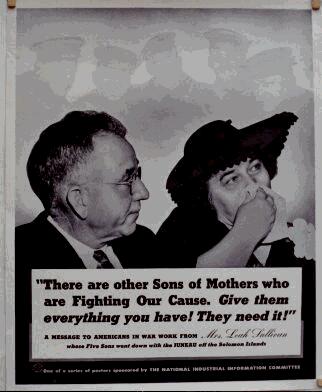
“It was a dream that my family has had since the christening of the ship and we felt so incredibly blessed to have had the opportunity to be involved with the festivities.” Those words describe the feelings of Kelly Sullivan Loughren, granddaughter of Albert Sullivan, one of the Fighting Sullivans. Her father, James, is the son of Albert, the only one of the five brothers who married. He and his four brothers from Waterloo, Iowa perished when their ship, the USS Juneau, was torpedoed and sunk during the sea battle for Guadalcanal in 1942. “My brother John and I made a promise eight years ago that we would go to Ireland if the ship ever made it there,” she said. Thomas Sullivan, Loughren’s great-grandfather, left Trafrask, Adrigole, Co. Cork, in 1849. Accompanying him during An Gorta Morta, the Great Hunger, was his wife Bridget Agnes and his brother Owen.
Both Gunner's Mate George Sullivan, 27, and Coxswain Francis Sullivan, 25, had four years of prior Navy service. Joe (Red), 23, Matt, 22 and Al., 19, became seamen, second class, when they enlisted and were assigned to the new $13,000,000 light cruiser, Juneau, the first American war ship commissioned in camouflage. Nine months later, during the Battle of Guadalcanal, near the Solomon Islands, she was steaming toward base when an explosion sent her to the bottom.
On April 17, 1997 Kelly Ann Sullivan Loughren and John Sullivan, grandchildren of Albert and the daughter of James and Sally Sullivan, were present at Stapleton Pier, Staten Island New York for the formal commissioning into the US Navy of the second The Sullivans (DDG68). Kelly is a schoolteacher in Cedar Falls, Iowa. The Arleigh Burke Class destroyer, with a crew of 26 officers and 315 sailors, is commanded by Richard A. Brown. The DDG68 visited Ireland this year for the O’Sullivan clan reunion and festivities. Loughren and her brother John stood on the shore to watch the ship come in. According to Loughren the locals welcomed the crew with open arms and made sure they experienced a taste of Irish culture.
A reception for the family was held on board the ship. Lougren said she felt like a proud mother when she saw the officers and crew at their best. “Overall, it was an experience of a lifetime, so amazing that it is difficult to explain in words. I only wish that I could bottle the feeling I get every time I'm on the ship! We were so honored to take part in this history making event for the best ship in the Navy.”
The ships crew met all the Sullivans from Castletownbere. Flynn said the people of Ireland and County Cork were “very warm and genuine to all of the ship’s crew. “It was a trip of a lifetime, and to be an Irish-American and visit Ireland on a US Navy ship – is something you could only dream of.” Flynn described his feelings for the World War II heroes. “The Sullivan brothers were courageous and loyal. Our country and the world itself is a better place because of this outstanding family. The motto of our ship is We Stick Together. It was also the motto of the Sullivan brothers. That is something we are all proud of."
JC Sullivan is an Irish-American writer residing in northeast Ohio. He witnessed the commissioning of the ship at Staten Island, New York.




Sunday, March 13, 2011
My Fight with Caveman
Just this week I had been thinking of updating a story I had previously written about when my family moved from the west side of Cleveland to the east side. When I wrote it JC was TJ to protect the guilty. I submitted "We're Moving to the East Side?" to the editor of the Plain Dealer Sunday Magazine. They had previously published "My First Flight". The new editor however had rejected this one, saying it appeared "contrived". Thinking about him this week for some reason, it was my intention to trim the original story and just post the part about my fight with "Caveman." In this morning's Plain Dealer is "Caveman's", Addison Anderson's, obituary.
In 1954, midway through the 7th grade, our family moved to the Buckeye Road area of Cleveland. I went from a mostly Irish-Catholic grade school to one that was primarily Hungarian. Why we moved is another story.
As far as I was concerned, the east side was the other side of the world. I was uncomfortable with the thought of moving again after only four years. I had plenty of good friends, was a Boy Scout, the catcher on the CYO baseball team and a guard on the basketball team. The new school had no sports teams at all. I would miss it all: school, friends, neighborhood and sports.
The house we were renting was smaller than our west side home and it sat in the rear of a front house. While the family was busy settling in, my education was restarted at St. Margaret of Hungary grade school.
Wanting to make my best and baddest impression on my first day at school, I carefully scanned the available supply of the clean clothes that were unpacked. The choices were pretty limited. Being the third of nine children of a Cleveland cop never allowed a budget for new and fashionable clothes. Hand-me-downs were the order in our family. I selected my favorite and best pair of trousers to wear, the pair that fit me best. Black with a gray stripe down the side, the cuffs were 'pegged', considerably smaller than the legs. A non-descript shirt completed my ensemble and, with growing feelings of uneasiness and dread, I headed off to begin the new day.
The 7th grade teacher, Sister Mary Broken Knuckles, was beyond the golden years. Halfway through the morning the school bell clanged loudly. A Fire Drill? Air raid? What, we get a recess? Now here was something different from St. Vincent De Paul - recess. Probably for the teachers' mental health rather than anything we students might gain. A fifteen-minute break to be spent outside in the playground. Great. The line out to recess was surprisingly orderly. Once out in the playground I was approached by a classmate.
"Hi, my name is Addison Anderson. When did you move here?"
Trouble began right away for what I heard was, "Hi, my name is Anderson Anderson." A little confused at meeting someone with the same first and last names, I repeated my question. "What's your first name?"
"Anderson," I again heard repeated.
"And what's your LAST name?"
"Anderson."
Still confused, I repeated the first question. "What did you say your FIRST name is?"
"ANDERSON, MY NAME IS ANDERSON ANDERSON" he exploded. "You a wise guy or something? You wanna fight me?"
I wasn't a wimp but I didn't want to fight anybody. The last fight I was pushed into was at St. V's. That one was with Gary Dixon, the class bull’s hitter who deserved to get knocked around a bit. That one was a draw. I was average in height and thin, but wiry. Now, faced with a fight on my first day at school, I hadn't any idea how to extricate myself from the challenge. I was also the new kid on the block. To back out of a fight would mean that I was 'chicken', a label that any red-blooded school kid feared being applied to him. Following my base instincts I scowled, "Name the time and place."
"In the lavatory, right after school," Anderson quickly responded, still angry with me for what he perceived as my attempt to make him look like foolish. Anderson had another name too - Caveman. Not a bad moniker for someone about to engage in a fight. Kind of intimidates the opposition right away. The word about the fight got around. The lavatory after school was crowded with guys trying to get ringside seats to witness the fracas.
Caveman and I immediately began the time-honored tradition of warrior dialogue as we slowly circled each other. "Come-on, wiseass, make a move."
“Besides being ugly I notice you don't use deodorant."
That was enough to begin the first and only round. We pounced on each other, trading headlocks, hammerlocks and half nelsons, finally rolling on the floor clutched in hand-to-hand combat. Caveman was the home team, cheered on all his partisan supporters. The fight probably lasted only about five minutes with no bloodshed. We tired quickly and, to my recollection, the fight was deemed a standoff, nobody losing, and winning each other's respect. Caveman might have had a different recollection of who won!
During the 7th and 8th grade Addison had the greatest birthday parties at home. His mother cleared out his bedroom and allowed us to have pillow fights in the dark, with refreshments served afterwords. It was great fun until the year we broke a bedroom window and his Mom freaked a bit about it.
In later years while I was stationed at Fort Hood, Texas, someone wrote me with his address in El Paso. He invited me to his "humble abode" but I was never able to scrape together the necessary $$ to get there. We lost touch after that. I'd heard he went to Viet Nam and,like so many returned veterans, suffered some issues afterwards. He apparently lived in plain sight here in the Cleveland area but we could never locate him for class reunions and breakfast get-togethers. I was saddened to learn he was right under our noses the whole the time.
I will see you on the other side Anderson Anderson
Subscribe to:
Posts (Atom)